

Niacinamide is more than just a skincare buzzword or trend. There's a reason this popular ingredient has made its way into more than a few best-selling skincare products — it's scientifically proven to benefit your skin, making it smoother, stronger, and more radiant.
Niacinamide has been shown to be particularly helpful for skin hyperpigmentation, a condition that occurs when skin cells produce too much melanin, causing some patches of skin to appear darker than others (commonly known as age spots or dark spots). Hyperpigmentation may be harmless, but it can leave people feeling self-conscious. If you're looking to minimize it, skincare products containing niacinamide can be a great option.
What Do Dermatologists and Medical Organizations Say About Niacinamide?
Topical niacinamide has been researched and utilized in dermatology for over 55 years. Authoritative sources — the AAD, Cleveland Clinic, or peer-reviewed research — say that the benefits of Niacinamide are consistently positive.
What is Niacinamide?
Niacinamide, sometimes also called nicotinamide, is a form of vitamin B3. Vitamin B3 helps convert food into energy and supports important cellular reactions. Because it is water-soluble, your body does not store it — meaning regular use is necessary to see continued benefits.
While vitamin B3 is found in supplements and certain foods (typically listed as nicotinic acid), topical products containing niacinamide are more directly beneficial for your skin. Niacinamide is particularly noted for helping minimize hyperpigmentation, but it has a broad range of other skincare benefits as well.
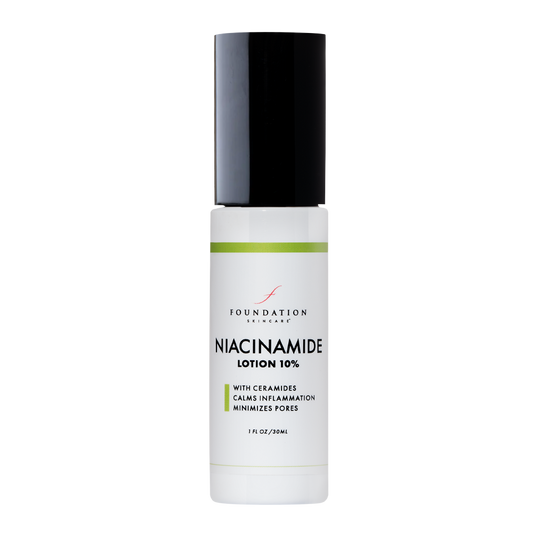
Niacinamide Lotion 10%
• Helps retain moisture and elasticity
• Reduces inflammation & redness
Benefits of Using Niacinamide
When applied topically, niacinamide has antioxidant effects and supports keratin production — a protein essential for healthy, strong skin. Clinical evidence supports the following benefits:
- Minimizes redness, skin discoloration, and blotchiness: Niacinamide can help reduce inflammation and strengthen your skin’s barrier, which in turn can help minimize redness and blotchiness from environmental conditions, acne, or rosacea. Studies back this up, showing that using niacinamide on a regular basis over several weeks can significantly improve blotchiness and yellowing.
- Helps control acne: Because niacinamide can reduce inflammation, it can also help control acne. One 2021 study found that regularly using niacinamide for 12 weeks led to a significant reduction in acne, especially when combined with benzoyl peroxide. Or you can try Foundation Skincare’s Azelaic Acid 14% that is a gentler option to help kill the bacteria on the skin’s surface and help reduce acne, along with many other benefits.
- Leaves skin more moisturized: According to Cleveland Clinic, niacinamide can enhance your skin’s lipid barrier, which helps lock in moisture while keeping pollutants and other irritants out. This leaves your skin looking and feeling more hydrated.
- Helps minimize the appearance of pores: Because niacinamide can make skin look more smooth and minimize discoloration, it can also minimize your pores.
- Reduces wrinkles and fine lines: Since niacinamide can increase protein production, it can be helpful in decreasing signs of aging like fine lines and wrinkles. Studies have shown that it can make a noticeable difference in reducing roughness and smoothing out the skin.
- Controls hyperpigmentation: Several studies have shown that niacinamide can significantly improve hyperpigmentation by improving skin’s barrier and reducing the appearance of dark spots.
What Causes Hyperpigmentation
Hyperpigmentation is a common skin condition that causes patches of skin to appear darker — presenting as brown, black, pink, gray, or red spots. According to the American Osteopathic College of Dermatology (AOCD) and the Cleveland Clinic, it occurs when the skin produces excess melanin, the pigment responsible for skin color, creating deposits that lead to discoloration.
Common causes include:
- Sun damage or tanning
- Genetics, such as inherited freckles
- Injuries to the skin, including acne scars
- Hormonal changes during puberty or pregnancy
- Medications, such as oral contraceptives
- Melasma
- Nutritional deficiencies, such as low B12 or folic acid
How Niacinamide Works on Hyperpigmentation
Topical niacinamide found in serums, moisturizers, and sunscreens can help minimize dark spots — and there is a solid body of peer-reviewed research to support this.
The mechanism: when applied to skin, niacinamide helps break down existing melanin deposits while also preventing new ones from forming. So it works on dark spots already present and helps stop new ones from developing.
How to Incorporate Niacinamide Into Your Skincare Routine
No prescription is required. Topical niacinamide is available in serums, moisturizers, sunscreens, and face masks. Most products use 5% niacinamide, though concentrations vary by brand.
Foundation's Niacinamide Lotion uses an impressive 10% concentration — formulated by a dermatologist and pharmacist — which is at the higher end of what research supports for visible results. It fades dark spots by reducing melanin deposits, boosts collagen to reduce aging signs, balances sebum to help control acne, and increases keratin to tighten pores. It also contains ceramides to keep skin hydrated and smooth.
You may also want to layer niacinamide alongside hyaluronic acid, which can boost absorption and provide additional barrier support. Foundation's Hyaluronic Acid Lotion can be applied after the Niacinamide Lotion to boost absorption, moisturize skin, and reduce the appearance of fine lines.
Niacinamide can be applied morning and evening. Apply it after cleansing and any other serums, but before moisturizer.
Realistic Expectations and Timeline
Niacinamide will not produce overnight results. Multiple studies have demonstrated meaningful benefits after 8 to 12 weeks of consistent use. It is essential to make niacinamide a daily part of your routine — alongside SPF 30 or higher sunscreen — over an extended period.
With regular use of Foundation's Niacinamide Lotion, many users begin noticing a difference in dark spots and overall skin tone after two to four weeks of daily and nightly use, with more significant improvement continuing beyond that.
If you're struggling with hyperpigmentation and looking to reduce dark spots, niacinamide is a well-supported, dermatologist-recognized option. Look for topical niacinamide in lotions or serums — and for a clinically formulated product, Foundation's 10% Niacinamide Lotion is a strong choice. Find more tips and resources at the FS Blog.
References
- PMC2921764 — Niacinamide: A B3 Vitamin with Dermatological Benefits
- Cleveland Clinic — Hyperpigmentation
- Cleveland Clinic — Niacinamide
- PubMed 18492135 — Effects of Niacinamide on Skin Pigmentation
- NCBI Bookshelf — Niacin and Niacinamide
- PubMed 17147561 — Niacinamide Skin Barrier Study
- AOCD — Hyperpigmentation
- PubMed 10971324 — 2000 Niacinamide Hyperpigmentation Study
- PMC3142702 — 2011 Melasma & Niacinamide Study
- PubMed 12100180 — Niacinamide Topical Applications
- Cleveland Clinic — Hyaluronic Acid
- PMC8594539 — 2021 Niacinamide & Acne Study


