
Key Takeaways:
-
Niacinamide and azelaic acid are skincare ingredients that target acne, redness, and hyperpigmentation in different ways.
-
Niacinamide helps regulate oil production, strengthen the skin barrier, and reduce inflammation, making it ideal for sensitive or acne-prone skin.
-
Azelaic acid helps to improve breakouts and discoloration by clearing acne-causing bacteria and reducing pigment production.
-
Using azelaic acid and niacinamide together helps address multiple skin concerns at once, including texture, tone, and inflammation.
Niacinamide and azelaic acid are two ingredients that dermatologists recommend to treat skin conditions such as acne, rosacea, melasma, and hyperpigmentation . Both of these ingredients have shown great efficacy in improving skin health, but they differ in their approach.
If you’re considering using our Niacinamide Lotion 10% or our Azelaic Acid 14% Cream, both of which are medical-grade and dermatologist-formulated, you may have some questions about how niacinamide and azelaic acid work, what they do, and how they compare to and interact with one another.
Here is everything you need to know about these two highly effective ingredients and how to use them.
What is Niacinamide?
A form of vitamin B3, niacinamide, also known as nicotinamide, is found in many natural sources, such as meat, fish, eggs, dairy products, green vegetables, and certain grains and cereals. Niacinamide is essential to the body’s ability to process carbohydrates, fats, and proteins and maintain the health of our cells.
Doctors recommend niacinamide supplements to prevent vitamin B3 deficiency and related conditions, and often recommend niacinamide topically to treat skin conditions such as acne, acne scars, hyperpigmentation, and visible signs of aging.
Benefits of Niacinamide for the Skin
-
Controls oil. Niacinamide is a powerful nutrient that increases the production of healthy fats in our skin known as ceramides, while simultaneously curbing the production of sebum, a natural oil produced by the skin that often contributes to acne.
-
Reduces pore size. It also reduces pore size, improves skin texture, and soothes inflammation and skin irritation caused by p. acnes bacteria, which helps to clear pustules, blemishes, and redness.
-
Non-irritating. Topical niacinamide is non-irritating when compared to many other acne treatments, and is therefore a great option for those with dry or sensitive skin.
-
Improves acne scarring. Research on the benefits of niacinamide have confirmed the efficacy of topical applications of niacinamide for acne scars, as well as the use of niacinamide for dark spots.
-
Builds immunity in the skin. Niacinamide also helps to build immunity in the skin against infections, and protects against the immunosuppressive action of solar UV rays, which helps to prevent lines, wrinkles, and premature aging.
-
Reduced melasma and eczema. It has also been used effectively to treat melasma and eczema, because it assists in the skin’s protein synthesis and helps the skin retain moisture to protect it against drying and damaging environmental factors. This contributes to stronger, healthier skin. Its anti-inflammatory properties also alleviate redness.
-
Repairs DNA. But perhaps the most powerful function of niacinamide is its contribution to the production of NADH, a naturally-occurring chemical that improves energy production at the cellular level and repairs DNA.
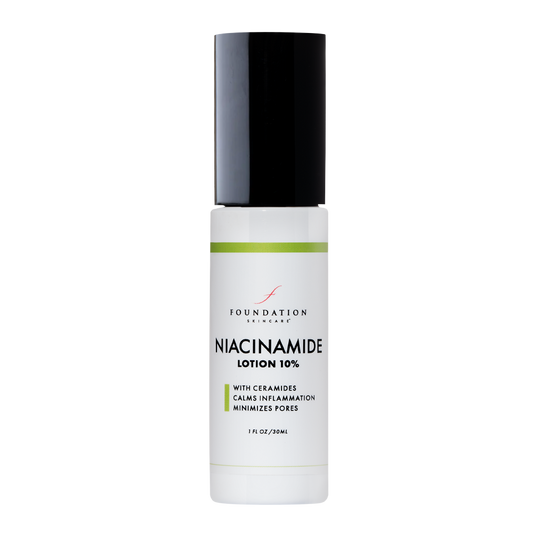
Our Niacinamide Lotion 10% stands out among similar products because it is formulated as a moisturizing lotion, with a synergistic combination of ingredients in a hyaluronic acid base. With a potent yet non-irritating 10% concentration of niacinamide, it allows this ingredient to offer maximum benefits to the skin. By comparison, many other solutions on the market only use this ingredient in concentrations between 1% to 2%.
This lotion improves the skin’s hydration and soothes to reduce redness, inflammation, blemishes, and pigmentation, renewing and protecting the skin.
Niacinamide Lotion 10%
• Helps retain moisture and elasticity
• Reduces inflammation & redness
Sale price
$45
• Helps retain moisture and elasticity
• Reduces inflammation & redness
What is Azelaic Acid?
A natural by-product of the beneficial yeast that lives on our skin, azelaic acid is a type of dicarboxylic acid known for its antibacterial, antioxidant, and anti-inflammatory properties.
It effectively clears acne-causing bacteria from the skin, which reduces acne breakouts, blemishes, irritation, and inflammation. It also safely reduces acne scars and post-acne discoloration, while improving the skin’s tone. This is why so many dermatologists prescribe azelaic acid for acne-prone skin.
Benefits of Azelaic Acid
-
Reduces acne-causing bacteria. Among its many beneficial properties, azelaic acid also reduces protein production in the skin, which helps to clear the accumulation of sebum and dead skin cells on the skin’s surface, reducing the growth of acne-causing bacteria.
-
Blocks excess oil production. Azelaic acid also blocks increased oil production caused by an elevation in testosterone levels, making it an ideal option for teens going through puberty, when acne flare ups may be linked to hormonal changes.
-
Safe for all skin types. Considered safe for all skin types, and for long-term daily use, azelaic acid may also be combined with other skin care products, lotions, and moisturizers, as no ingredients are contraindicated for use with it.
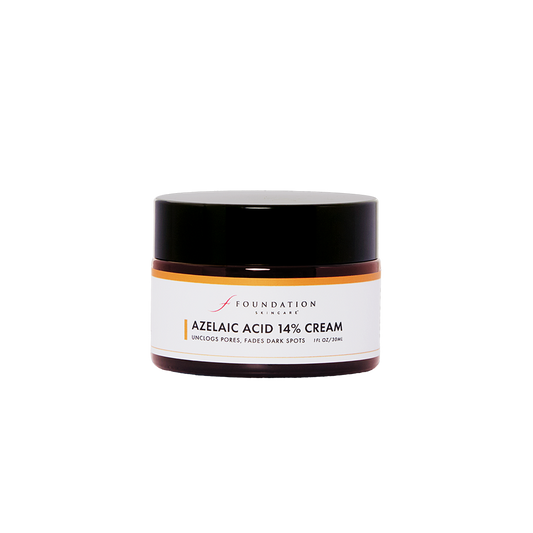
Our Azelaic Acid 14% Cream is formulated by a specialized team of chemists and dermatologists in a hydrating, water-soluble cream base to improve skin conditions such as acne, age spots, hyperpigmentation, melasma, and rosacea, while protecting against dryness and irritation.
For skin brightening and to improve pigmentary disorders, azelaic acid is effective due to its ability to block the skin’s natural process of pigment production, reducing brown spots, hyperpigmentation, and melasma. It’s also a less abrasive and far less controversial treatment than hydroquinone, as well as a much safer option for long-term use.
Azelaic Acid 14% Cream
• Brightens skin, fades brown spots
• Unclogs pores, improves texture
Sale price
$45
• Brightens skin, fades brown spots
• Unclogs pores, improves texture
Can You Use Them Together?
Absolutely! First apply the Niacinamide Lotion 10%, and then follow up with the Azelaic Acid 14% Cream.
To further moisturize and protect your skin, you may add a layer of our Vitamin C Lotion 10% and/or our Hyaluronic Acid Lotion, always applying the thinnest products first and ending with the thickest.
Wash hands between each application and allow each product to dry on your skin before applying the next layer.
How to use our Foundation Skincare Products ( twice daily):
-
Cleanse face with a mild cleanser and pat dry.
-
Apply a thin layer of Niacinamide Lotion 10%.
-
(Optional) Apply a thin layer of Vitamin C Lotion 10% or Hyaluronic Acid Lotion.
-
Apply Azelaic Acid 14% Cream in a gentle, circular motion, focusing on trouble spots.
-
Apply a sunscreen with SPF 30 or higher before going outdoors.
The Bottom Line
Niacinamide and azelaic acid are both highly effective skincare ingredients that can be used together to improve skin tone and texture. But is one better than the other? Here’s what you should know:
-
Niacinamide helps to calm inflammation and minimize pores. It also helps regulate oil production and strengthens the skin barrier, making it a great option for calming and maintaining overall skin health.
-
Azelaic acid targets acne and discoloration more directly. It supports skin by eliminating acne-causing bacteria and slowing pigment production, helping to clear breakouts and fade dark spots over time.
-
Niacinamide and azelaic acid can be used together. Layering niacinamide with azelaic acid allows you to address multiple concerns, like acne, redness, and hyperpigmentation, at the same time.
-
Both ingredients are safe for all skin types. Compared to harsher treatments, they’re suitable for a wide range of skin types, including sensitive skin, when used consistently.
Sometimes, choosing the right approach for your skincare routine comes down to your primary concerns. If you’re looking to improve overall skin tone and calm irritation, niacinamide is a strong foundation. If your main concern is acne or discoloration, azelaic acid may offer more targeted results. However, for most people, using both products together provides the most balanced approach. Find out more in the FS Journal.
References:
-
Kazemeini SA, et al. (2025). Evidence-Based Topical Therapy for Facial Scars in Diverse Skin Types. https://pmc.ncbi.nlm.nih.gov/articles/PMC12275165/
-
Marques CI, et al. (2024). Mechanistic Insights into the Multiple Functions of Niacinamide: Therapeutic Implications and Cosmeceutical Applications in Functional Skincare Products. https://pmc.ncbi.nlm.nih.gov/articles/PMC11047333/
-
National Institutes of Health Office of Dietary Supplements. (2022). Niacin. https://ods.od.nih.gov/factsheets/Niacin-HealthProfessional/
-
Navarrete-Solís JO, et al. (2011). A Double-Blind, Randomized Clinical Trial of Niacinamide 4% versus Hydroquinone 4% in the Treatment of Melasma. https://pmc.ncbi.nlm.nih.gov/articles/PMC3142702/
-
Sauer NA, et al. (2024). The multiple uses of azelaic acid in dermatology: mechanism of action, preparations, and potential therapeutic applications. https://pmc.ncbi.nlm.nih.gov/articles/PMC10809820
-
Thompson BE, et al. (2014). Nicotinamide enhances repair of ultraviolet radiation-induced DNA damage in primary melanocytes. https://pubmed.ncbi.nlm.nih.gov/24798949/
-
Zhu JU, et al. (2023). A single‐center, randomized, controlled study on the efficacy of niacinamide‐containing body emollients combined with cleansing gel in the treatment of mild atopic dermatitis. https://pmc.ncbi.nlm.nih.gov/articles/PMC10509598/


