
Key Takeaways:
-
Azelaic acid is a first-line topical treatment for mild-to-moderate rosacea because it can help reduce redness, inflammation, and acne-like bumps.
-
Azelaic acid may also improve uneven skin tone and discoloration thanks to its skin-brightening properties.
-
Most over-the-counter azelaic acid products contain lower concentrations, while higher-strength formulas may provide more noticeable results.
-
Consistent long-term use, along with sunscreen and a gentle skincare routine, may help better manage rosacea flare-ups over time.
There is no cure for rosacea, but there are ways to reduce its signs and symptoms, including using azelaic acid.
Rosacea is an inflammatory skin condition that causes redness and visible blood vessels, typically on the nose and cheeks. It can also cause small, pus-filled bumps on the face, which can resemble acne.
According to the American Academy of Dermatology, more than 14 million people are living with rosacea in the U.S., and women are more likely to be affected than men.
Read on to find out what causes this skin condition, how to know if you have it, and how to use azelaic acid for rosacea flare-ups.
What Causes Rosacea & Symptoms
While researchers are unsure what causes rosacea, there are some potential risk factors. The skin condition is more likely to impact women over age 30, especially if they have a family history of rosacea.
Some studies also link the skin condition with other autoimmune diseases such as type 1 diabetes, celiac disease, multiple sclerosis, and rheumatoid arthritis.
Potential triggers for rosacea flare-ups are those that tend to induce inflammation in the body. These may include hot drinks and spicy foods, red wine, temperature extremes, emotions, exercise, and certain medications like those used to treat high blood pressure.
Symptoms of rosacea vary person to person but may include:
-
Persistent facial blushing or flushing, which is more noticeable on light skin
-
Visible blood vessels, or spider veins
-
Pus-filled bumps resembling acne
-
Hot and tender skin
-
Dry, irritated, and itchy eyes or eyelids
-
Thickening skin, usually around the nose, which is more common in men
What Is Azelaic Acid?
Azelaic acid is a dicarboxylic acid and a natural byproduct of yeast. It can be found in grains like barley, wheat, and rye as well as certain fungi on the skin. Due to its antimicrobial, anti-inflammatory, and antioxidant properties, azelaic acid has been shown to benefit skin conditions like acne, hyperpigmentation, and rosacea.
Azelaic acid works much like benzoyl peroxide and salicylic acid in its ability to unclog pores and exfoliate skin, but it is less abrasive and gentler, making it ideal for sensitive skin. This is especially true if you use a formulation made without a gel base.
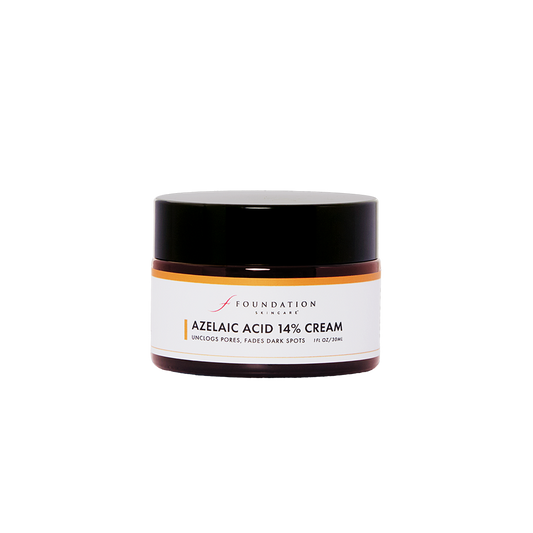
Foundation Skincare Azelaic Acid Cream contains an effective 14% concentration of azelaic acid in a water soluble cream formulation. This is the highest concentration you can get without a prescription.
Many over-the-counter formulas have a lower concentration, making them much less effective, while prescription-based azelaic acid formulas are made with a gel base, which can be drying and irritating. Foundation Skincare Azelaic Acid Cream is so gentle it can be used morning and night. It is also milled four times for a fluffy lotion that glides on nicely and helps the azelaic acid absorb much more effectively into the skin.
Main Benefits of Azelaic Acid
From encouraging cell turnover to reducing inflammation, there are many benefits associated with azelaic acid. They include:
-
Clears up acne and helps prevent future breakouts: Azelaic acid helps treat acne by killing bacteria that infect pores and decreasing the production of keratin, which can contribute to breakouts.
-
Soothes redness and inflammation: Azelaic acid has potent anti-inflammatory effects, which helps to reduce redness and swelling caused by rosacea.
-
Repairs damaged skin: Azelaic acid’s anti-inflammatory and antioxidant properties may help improve skin texture, support skin renewal, and reduce visible signs of skin damage.
-
Brightens skin and improves uneven skin tone: Azelaic acid inhibits tyrosinase, an enzyme associated with melanin production.This means it can effectively lighten skin while diminishing the appearance of hyperpigmentation.
Azelaic Acid 14% Cream
• Brightens skin, fades brown spots
• Unclogs pores, improves texture
Sale price
$45
Is Azelaic Acid Best For Rosacea?
Azelaic acid is a potent formula for rosacea due to its anti-inflammatory, antimicrobial, and antioxidant properties. Studies show it is an effective and well-tolerated first-line topical treatment for mild-to-moderate papulopustular rosacea, helping to resolve symptoms like redness, inflammation, and acne-like bumps. first-line topical treatment for patients with hyperpigmentation disorders like rosacea.
Studies show significant improvement in the number of inflammatory rosacea lesions after up to 15 weeks of consistent azelaic acid use. Some patients may begin noticing improvements in redness and inflammatory lesions in 6–12 weeks, though long-term use is often recommended to help manage ongoing rosacea symptoms..
Azelaic acid has also been found to be more effective in treating rosacea compared to other treatments, such as metronidazole gel. In one older study, azelaic acid reduced more inflammatory lesions than metronidazole gel and showed continual improvement over 15 weeks while the effects of metronidazole gel plateaued after just 8 weeks.
How It Works & How To Use It
When using Foundation Skincare Azelaic Acid 14% Cream, follow these steps for the best results:
-
Apply after cleansing. Apply a pea-sized amount of the product after using a gentle cleanser. Avoid using it on your eyes, lips, and mouth.
-
Allow the product to absorb. Before you apply moisturizer, allow the skin to absorb the product, especially in the most affected areas.
-
Use sunscreen. Protect skin by applying a sunscreen with an SPF of 30 or higher.
-
Use it twice a day. Apply azelaic acid in the morning and night and plan to use long term for the best results.
Foundation Skincare Azelaic Acid Cream also pairs nicely with other products like our Niacinamide Lotion 10%, which calms skin and contributes to DNA repair. It can also be used with our Hyaluronic Acid Lotion, which hydrates skin and locks in moisture. But you should always use azelaic acid last in your routine,but before moisturizer and SPF.
Bottom Line on How to Use Azelaic Acid for Rosacea
We may not have a cure for rosacea yet, but azelaic acid may help reduce many of its most frustrating symptoms, including redness, inflammation, and acne-like bumps.
Here’s what you should know:
-
Azelaic acid is a research-backed treatment for rosacea. Studies suggest it’s an effective and well-tolerated option for people with mild-to-moderate rosacea.
-
Consistency matters when treating rosacea. Some people notice improvement within a few weeks, but long-term use is often needed to maintain results and reduce flare-ups.
-
Gentle formulations may be better for sensitive skin. Cream-based formulas may feel less irritating and drying than some gel-based prescription options.
-
Sun protection is essential. Daily sunscreen use can help protect sensitive skin and reduce triggers that may worsen rosacea symptoms.
Learn more about how the Foundation Skincare collection can improve the appearance of your skin and hair without a prescription.
References:
-
American Academy of Dermatology Association. (2024). Rosacea: Causes. https://www.aad.org/public/diseases/rosacea/what-is/causes
-
Egeberg AL, et al. (2016). Clustering of autoimmune diseases in patients with rosacea. https://pubmed.ncbi.nlm.nih.gov/26830864/
-
Elewski BO, et al. (2003). A Comparison of 15% Azelaic Acid Gel and 0.75% Metronidazole Gel in the Topical Treatment of Papulopustular Rosacea. https://jamanetwork.com/journals/jamadermatology/fullarticle/479570
-
Gether L, et al. (2018). Incidence and prevalence of rosacea: a systematic review and meta-analysis. https://onlinelibrary.wiley.com/doi/10.1111/bjd.16481
-
King SA, et al. (2023). A systematic review to evaluate the efficacy of azelaic acid in the management of acne, rosacea, melasma and skin aging. https://onlinelibrary.wiley.com/doi/full/10.1111/jocd.15923
-
MedlinePlus. (2016). Azelaic Acid Topical. https://medlineplus.gov/druginfo/meds/a603020.html
-
Sauer NA, et al. (2024). The multiple uses of azelaic acid in dermatology: mechanism of action, preparations, and potential therapeutic applications.
https://pmc.ncbi.nlm.nih.gov/articles/PMC10809820/


