
Key Takeaways:
- Azelaic acid strengths range from 10%–14% OTC formulas to 15–20% prescription-strength azelaic acid, with higher percentages generally studied more extensively.
- 10% azelaic acid can help with mild acne and uneven skin tone and may be better tolerated for those with extra sensitive skin.
- Prescription azelaic acid (15%–20%) is commonly used for conditions like rosacea and inflammatory acne but may cause dryness or irritation in some users.
- 14% azelaic acid offers a middle-ground approach, helping target acne, rosacea, dark spots, and texture—without requiring a prescription and with a lower risk of irritation than higher strengths.
Most over-the-counter products with azelaic acid, including Paula’s Choice® and The Ordinary®, do not contain more than 10% of the active ingredient. For some individuals, this concentration is not enough to produce real results when it comes to fading dark spots and clearing up acne.
To get a higher percentage of the active ingredient, many people turn to prescription azelaic acid, which typically contains 15-20% of the active ingredient. However, some individuals experience dryness and irritation with the higher concentration. At Foundation Skincare, we find that 14% is just the right amount to make a significant improvement in skin health without causing irritation. Read on to find out more about azelaic acid benefits and how to choose the right strength.
What Is Azelaic Acid?
Azelaic acid is a naturally occurring dicarboxylic acid commonly found in wheat, barley, and other grains. It is also produced by a type of fungi on the skin. With potent antimicrobial, antioxidant, and anti-inflammatory properties, azelaic acid is highly effective at neutralizing free radicals. Azelaic acid benefits include reducing acne breakouts, calming irritation, and slowing the buildup of protein on the skin.
At the same time, azelaic acid functions as a tyrosinase inhibitor. Tyrosinase is an enzyme responsible for melanin synthesis, which produces pigment in the skin. By inhibiting it, azelaic acid helps to fade hyperpigmentation and brighten skin.
There is some evidence that azelaic acid may also be useful in reducing signs of premature aging. When combined with other skin-nourishing nutrients like vitamins C, E, and A, azelaic acid has been clinically proven to improve skin elasticity and flexibility, reduce wrinkles, and even out skin tone.
Azelaic Acid Strengths: How 10%, 14%, and Prescription Options Compare
When it comes to choosing between azelaic acid strengths, the decision depends on your specific skin concerns and tolerance.
Prescription-strength products may seem like the better choice because their concentration is higher, but this isn’t always the case, especially if you have sensitive skin. At the same time, using a low concentration may not have a noticeable impact. Here is some guidance on how to choose the right concentration for your skin.
Benefits of Azelaic Acid 10%
Prescription-strength azelaic acid products are often preferable to OTC versions because they have higher concentrations of the active ingredient, but a 10% strength can still be effective for some users.
For instance, in one 2021 study, patients with mild to moderate acne using azelaic acid gel 10% saw a success rate of 36.51% after eight weeks compared to 30.37% in those using azelaic acid cream 20%. The lower concentration also had a higher safety profile with one patient using the 20% cream experiencing an adverse event.
Researchers explained that the benefits of using a lower concentration had more to do with avoiding such adverse events like burning, stinging, itching, dry skin, erythema, and irritation, which has been seen in higher concentrations.
Benefits of Azelaic Acid 14%
Though the study above illustrated that the 10% concentration of azelaic acid was slightly more effective and generally safer than the higher 20% concentration cream in treating acne, it does not appear to be as effective at treating other skin conditions like hyperpigmentation and premature aging. Instead of opting for 20% and risking the chance of experiencing side effects, it is recommended to use a slightly higher concentration of 14%.
Most studies on the slightly higher concentration use products with 15% azelaic acid, but this concentration is only available with a prescription. This makes 14% azelaic acid a practical alternative to prescription azelaic acid, offering stronger results without a prescription.
In one 2021 study, patients using azelaic acid 15% experienced a significant decrease in inflammatory lesions and erythema associated with rosacea. No irritation or relevant side effects were noted. Patients using 15% azelaic acid also had a significant reduction in acne scarring after using the product for six months. And higher concentrations of azelaic acid have also proven to be useful in reducing wrinkles and fine lines as shown in one 2022 study.
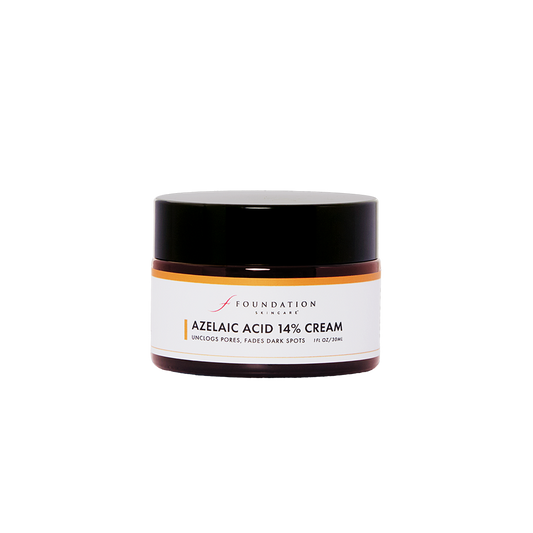
Azelaic Acid 14% Cream
• Brightens skin, fades brown spots
• Unclogs pores, improves texture
Key Differences Between Azelaic Acid Strengths
The key differences between azelaic acid 10% and azelaic acid 14% is that the higher concentration treats more conditions. However, using a higher concentration (especially 20%, a typical prescription strength) may cause side effects, like irritation. Most higher concentrations above 14% also require a visit to a dermatologist’s office for a prescription.
Benefits of azelaic acid 10%:
-
Effective in reducing mild to moderate acne
-
Less irritation than 20% azelaic acid products
Benefits of azelaic acid 14%:
- Effective in treating acne, acne scarring, hyperpigmentation, rosacea, and premature aging
-
Highest percentage available without a prescription
-
Less irritating than 20% concentrations, especially when combined with calming and hydrating ingredients like aloe leaf juice and jojoba seed oil (found in Foundation Skincare’s Azelaic Acid 14% Cream)
How to Use Azelaic Acid
Foundation Skincare’s Azelaic Acid 14% Cream is suitable for individuals dealing with acne, rosacea, hyperpigmentation, and premature aging.
Dermatologist formulated with a cream base, the product can be used daily without irritating skin like so many of the serums and gels. Other ingredients like jojoba seed oil, avocado oil, and aloe leaf help to ensure a soothing application.
With its medical-grade 14% concentration, you may find that you have to build up to using twice daily as your skin adjusts. It also layers well with other products in the Foundation Skincare collection. We recommend the following routine to get started:
Morning:
-
Cleanse skin and pat dry.
-
Apply any other serums, such as Niacinamide Lotion 10%, which calms skin and contributes to DNA repair. Azelaic acid also pairs well with Vitamin C Lotion 20% to increase firmness and elasticity while brightening skin.
-
Moisturize with Hyaluronic Acid Lotion, which works as a magnet for skin hydration.
-
Apply a thin layer of Azelaic Acid 14% Cream to kill bacteria and reduce redness and inflammation.
-
Protect with minimum SPF 30+: (50 preferred) mineral-based broad spectrum sunscreen.
Evening
-
Cleanse and apply Niacinamide Lotion 10%.
-
Moisturize and restore with Night Renewal Cream with 2% Granactive™ Retinoid to improve skin texture.
You may also want to consider using a nutritional supplement to support your skin health from the inside out. If your main concern is hyperpigmentation, try Foundation Skincare’s Pigmentation Defense to further improve visible signs of skin discoloration with its custom blend of antioxidants, vitamins, and herbs. Or, use Foundation Skincare’s Spectrum supplement to support skin renewal and prevent further sun damage through plant-based antioxidants and key vitamins like vitamin D and oral niacinamide.
The Bottom Line
Azelaic acid strength matters, but more isn’t always better. Here’s what you should know:
-
Higher strengths aren’t always necessary. Prescription-strength azelaic acid (15–20%) is well-studied, but it may cause irritation, especially if you have sensitive skin.
-
A lower strength may work for some, but may not be strong enough for others. Lower-strength formulas like 10% azelaic acid can help with mild acne and uneven tone, particularly if your skin is easily irritated.
-
14% azelaic acid offers the highest strength without a prescription. A 14% formula may deliver broader azelaic acid benefits, like improving acne, hyperpigmentation, and redness, without the downsides of higher strengths.
Remember, no two people have the same skin concerns. Starting with a 14% strength is an ideal way to find out if azelaic acid is right for your skin. It gives you the advantage of a higher concentration of the active ingredient without needing a prescription, but is formulated to be gentle enough for even the most sensitive skin.
Learn more about the benefits of azelaic acid and find more tips on how to care for your skin in the FS Journal.
FAQs
What percentage of azelaic acid is most effective?
Prescription-strength azelaic acid (15–20%) has the most clinical research behind it, but lower strengths like 10% and 14% can still be effective depending on your skin type and concerns.
Is azelaic acid 10% strong enough?
For some users, yes. Azelaic acid 10% can be effective for mild acne, uneven tone, and sensitive skin, though results may be more gradual compared to higher strengths.
Is azelaic acid 14% better than 10%?
Azelaic acid 14% may be more effective for concerns like hyperpigmentation, rosacea, and acne while still being gentler than prescription-strength options.
What’s the difference between azelaic acid 10% vs. 15%?
The main difference between azelaic acid 10% vs 15% is strength and accessibility.
15% is only available with a prescription and more studied for inflammatory conditions, while 10% is OTC and better tolerated.
Do you need a prescription for azelaic acid?
Higher concentrations (15–20%) are considered prescription-strength, while 10% and 14% formulas are available over the counter.
Can you use azelaic acid every day?
Yes, most people can use azelaic acid once or twice daily, though it’s best to start slowly and increase your frequency once you build up tolerance.
Resources:
-
Dall’Oglio FE, et al. (2021). A novel azelaic acid formulation for the topical treatment of inflammatory rosacea: A multicentre, prospective clinical trial. https://pmc.ncbi.nlm.nih.gov/articles/PMC8252084/
-
Layton AL, et al. (2023). Real-World Case Studies Showing the Effective Use of Azelaic Acid in the Treatment, and During the Maintenance Phase, of Adult Female Acne Patients. https://pmc.ncbi.nlm.nih.gov/articles/PMC9975535/
-
Markiewicz-Tomczyk AG, et al. (2022). Clinical evaluation of anti-aging effects of combined therapy—Azelaic acid, phytic acid, and vitamin C applied layer by layer in females with Fitzpatrick skin types II and III. https://onlinelibrary.wiley.com/doi/10.1111/jocd.15359
-
Tomić IV, et al. (2021). Efficacy and Safety of Azelaic Acid Nanocrystal-Loaded In Situ Hydrogel in the Treatment of Acne Vulgaris. https://pmc.ncbi.nlm.nih.gov/articles/PMC8073278/
-
Wang ZH, et al. (2021). Pegylated azelaic acid: Synthesis, tyrosinase inhibitory activity, antibacterial activity and cytotoxic studies. https://www.sciencedirect.com/science/article/abs/pii/S0022286020315544


