Hair loss is one of those problems where patients often arrive at the dermatologist's office having already diagnosed themselves—and sometimes having tried several shampoos, supplements, serums, and medications.
My approach is usually the opposite: first determine what type of hair loss is occurring, then decide what treatment actually makes sense.
Hair can change as we age, and you can start paying attention to those changes early. I like to talk about nutrition at the first visit. Our UnTangled Hair Supplement is an option I discuss early in building a routine.
Hair loss is rarely a one-visit process. Because hair grows slowly, the initial appointment is usually about establishing the diagnosis and a baseline. Subsequent visits tell us whether the process is stabilizing, whether treatment is working, and whether we need to adjust the plan.
What happens at the first appointment?
The first thing I want to determine is whether the patient is experiencing shedding, progressive thinning, discrete areas of hair loss, or some combination of these.
Those patterns can represent very different conditions.
Some people are losing increased numbers of hairs but still have normal overall density. Others have very little noticeable shedding but are gradually developing a wider part, receding hairline, or thinner ponytail because individual follicles are producing progressively smaller hairs.
I ask when the problem began and whether it appeared suddenly or gradually. I also ask about family history, medications, diet, weight changes, pregnancy when applicable, and recent illnesses or major life events.
One particularly important point is that hair shedding frequently lags behind its trigger by two or three months. A patient may be losing hair in September because of an illness, surgery, high fever, major emotional stress, rapid weight loss, or other physiologic stress that occurred in June.
Rapid weight loss is something I ask about routinely now, including weight loss associated with GLP-1 medications. The medication itself is not necessarily the problem—the significant metabolic and nutritional change accompanying rapid weight loss may trigger a telogen effluvium. So it’s important to prioritize filling this nutrition gap, potentially by starting a well balanced hair growth supplement.
What am I looking for when I examine the scalp?
The pattern matters enormously.
With androgenetic, or pattern hair loss, I may see progressive miniaturization of the hairs in characteristic areas of the scalp. With telogen effluvium, the shedding tends to be more diffuse.
Discrete bald patches raise an entirely different set of possibilities, including alopecia areata.
I am especially attentive to redness, perifollicular scale, pustules, crusting, pain, burning, or areas where the scalp appears unusually smooth or shiny. Those findings may suggest an inflammatory or scarring form of alopecia.
That distinction matters because some scarring alopecias can permanently destroy hair follicles. Those are conditions where early diagnosis is particularly important.
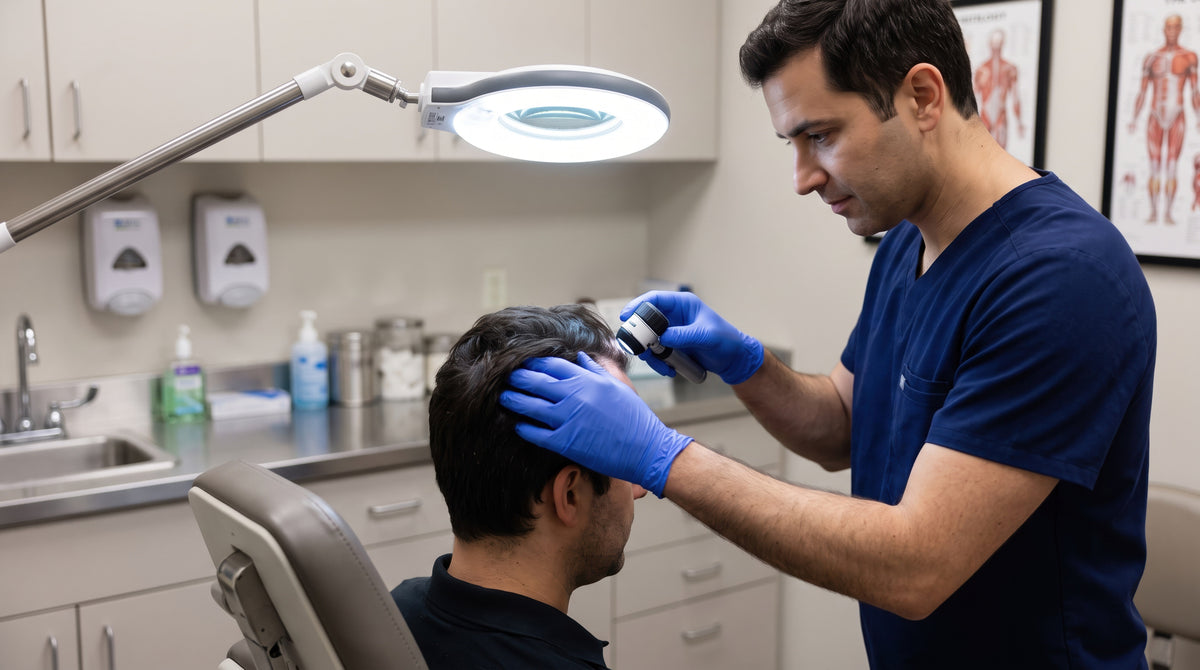
Dermoscopy, sometimes called trichoscopy when used on the scalp, allows me to examine the follicles and individual hairs much more closely.
Occasionally, particularly when I am concerned about inflammatory or scarring alopecia, a small scalp biopsy is necessary.
Why do I usually ask patients to take photographs?
Hair changes too slowly for human memory to be particularly reliable.
I encourage patients to take baseline photographs of the hairline, temples, center part, and crown using the same lighting, hairstyle, location, and camera angle whenever possible.
We can then compare those images several months later.
I am looking at things such as part width, scalp visibility, hairline position, and overall density—not whether someone counted 73 hairs in the shower one morning.
Those photographs often become one of our most useful tools at follow-up visits.
Do I order blood tests on everyone?
No.
Laboratory testing should be guided by the history and examination rather than ordering every vitamin and hormone level imaginable.
Depending on the patient, I may evaluate a CBC, ferritin and iron studies, thyroid function, and occasionally vitamin D, B12, zinc, or other nutritional studies.
Iron deficiency is particularly important to consider in menstruating women and in people with restrictive diets, substantial blood loss, or significant dietary changes.
If someone actually has a nutritional deficiency, correcting it is important. But it’s critical to take the vitamins and minerals needed in proper doses, as too much of some vitamins can actually cause more hair loss.
That is also why I am cautious about high-dose biotin. True biotin deficiency is uncommon, and very high supplemental doses can interfere with several important laboratory tests.
More testing and more supplements do not necessarily mean better treatment.
How do I decide where treatment starts?
Treatment depends on the diagnosis.
If someone has a classic telogen effluvium following an illness, surgery, pregnancy, rapid weight loss, or another temporary physiologic stress, the most important treatment may simply be addressing the underlying trigger and allowing the hair cycle to recover.
If the examination shows androgenetic or pattern hair loss, then I start discussing treatments designed to preserve follicles and improve density.
If the patient has alopecia areata, inflammatory scalp disease, or a scarring alopecia, the treatment pathway is completely different.
Where does UnTangled fit into a hair care routine?
For adults who want to be proactive about their hair as they age, we formulated UnTangled Hair Supplement as a daily option for nutritional support. It brings vitamins, minerals, and other ingredients together in a dermatologist-formulated blend designed to support healthy hair growth.
UnTangled can be one of the first steps in your daily hair care routine. It can also be the part you keep consistent as we layer in other treatments. For someone with pattern thinning, for example, I may recommend topical minoxidil from the start. At follow-up, we can adjust the treatment plan and revisit whether other changes are also recommended.
Bring your supplement list to the visit, especially if you already take a multivitamin. UnTangled contains biotin, so mention it before any blood tests.
When do I recommend topical minoxidil?
Topical minoxidil remains one of the treatments I use most frequently for appropriate patients with pattern hair loss.
It is particularly reasonable when someone has early or moderate thinning, wants a well-established topical treatment, and is willing to use it consistently.
The most important discussion I have with patients is about expectations.
Hair grows slowly. We generally judge meaningful changes in months rather than weeks, and treatment needs to be continued to maintain the benefit.
Some patients also experience a temporary increase in shedding shortly after starting minoxidil. That can be alarming if they were not expecting it, but it does not necessarily mean the treatment is making their condition worse.
When would I consider oral minoxidil instead?
Low-dose oral minoxidil has become an increasingly useful option in dermatology, although its use for hair loss remains off-label.
I may consider it when someone has difficulty consistently applying topical minoxidil, develops significant irritation from topical products, has diffuse areas that make topical treatment cumbersome, or simply has a clinical situation where oral therapy makes more sense.
But oral minoxidil is not something I prescribe automatically.
Before recommending it, I consider blood pressure, cardiovascular history, other medications, a history of edema or fluid retention, and pregnancy status when relevant.
Potential side effects include increased facial or body hair, dizziness, increased heart rate, and fluid retention. More significant cardiovascular adverse effects are uncommon at the low doses used for hair disorders but are part of the reason treatment should be individualized.
For the right patient, however, oral minoxidil can simplify treatment considerably.
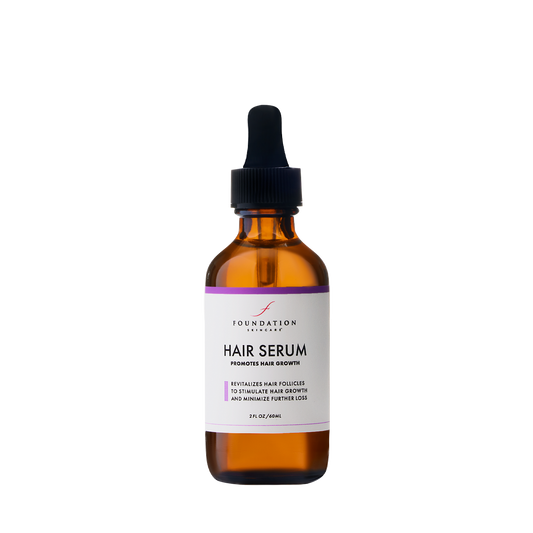
Where does the Foundation Hair Serum fit into treatment?
I view our Foundation Hair Serum as a supportive topical treatment rather than a replacement for medical therapy when medical therapy is indicated.
It is minoxidil-free and combines ingredients including Stimucap and Capixyl along with additional ingredients intended to support the scalp and hair-follicle environment.
I particularly like it for patients who want a non-drug topical option, patients with relatively mild thinning who are not ready to start a medication, or as an adjunct to a broader hair-loss regimen.
The important distinction is that I don't want patients to believe that every cosmetic ingredient has the same level of clinical evidence as medications such as minoxidil. I would rather be transparent about what each component of a regimen is intended to accomplish.
Can Foundation Hair Serum and topical minoxidil be used together?
In appropriate patients, yes.
I would not mix the two products together or apply one immediately on top of the other while they are still wet.
Minoxidil should be applied directly to a dry scalp and allowed to dry. The serum can be applied at another time of day or after the minoxidil has completely dried.
The practical issue is usually not a dangerous interaction. It is scalp irritation and making a regimen so complicated that the patient stops using everything.
If someone develops redness, itching, burning, or significant scale after adding multiple topical products, I usually simplify the regimen and determine which product is responsible.
What happens at the follow-up appointment?
Usually, we compare the patient with their baseline rather than simply asking, "Do you think it is better?"
That means reviewing photographs, looking at the scalp again with dermoscopy, asking about shedding, assessing density, and determining whether treatment has been used consistently.
At three or four months, I am often looking for evidence that the process is stabilizing.
By six months and beyond, changes in density become easier to judge.
If treatment is working and well tolerated, we usually continue it.
If UnTangled is already part of your routine, we can review how it’s fitting in while we decide whether to add or adjust a topical or prescription treatment.
If it is not, I ask why.
Was the original diagnosis correct? Is there continuing iron deficiency or thyroid disease? Is the patient still rapidly losing weight? Are they actually using the treatment? Is there underlying pattern hair loss that became apparent after a telogen effluvium?
Sometimes the correct answer is to increase treatment. Sometimes it is to change treatment. And occasionally the correct answer is simply to give a treatment that is already working more time.
What are the biggest mistakes I see patients make?
One is starting five things simultaneously.
If someone begins a supplement, new shampoo, hair serum, topical minoxidil, and another medication on the same weekend, it becomes very difficult to determine what is helping—or what is causing a side effect.
Another mistake is assuming that every episode of hair loss is caused by stress.
Stress can absolutely cause shedding, but genetics, hormonal factors, nutritional deficiencies, autoimmune disease, medications, inflammatory scalp disease, and numerous other conditions can cause hair loss as well.
And probably the most important mistake is waiting too long to take action.
Hair that is temporarily shed can often grow again.
A follicle that has been permanently destroyed by a scarring process cannot.
When should someone make an appointment sooner rather than later?
I would recommend earlier dermatologic evaluation for:
-
Discrete bald patches.
-
Rapidly progressive loss.
-
Significant scalp pain, burning, itching, redness, scaling, pustules, or crusting.
-
Smooth or shiny areas that may represent scarring.
-
Unexplained loss of the eyebrows or eyelashes.
-
Hair loss in a child.
-
Persistent shedding accompanied by clearly decreasing density.
If hair loss is mild, diffuse, and follows an obvious temporary trigger, observing it for a short period can be reasonable.
But you do not need to wait until hair loss becomes severe before seeing a dermatologist. With many chronic hair disorders, our best opportunity is to preserve healthy follicles before they are significantly miniaturized or damaged.
What's the most important thing patients should remember?
Don't diagnose your hair loss based on one shower drain.
Take photographs. Look for a pattern. Think back several months for possible triggers. And avoid changing ten things at once.
Most importantly, determine what type of hair loss you have before deciding how to treat it.
There are many causes of hair loss, and many of them are treatable. Once we understand the cause, we can build a routine you can stick with and adjust it as your hair changes.
If you’re looking for a daily way to support healthy hair as you age, explore UnTangled Hair Supplement and see your dermatologist to get a proper diagnosis.