
Key Takeaways:
-
Both Foundation Skincare’s Azelaic Acid 14% Cream and The Ordinary Azelaic Acid 10% Suspension can help with concerns like acne, rosacea, and hyperpigmentation, but they differ in formulation and concentration.
-
Foundation Skincare’s formula contains a higher, medical-grade concentration of azelaic acid at 14%, while The Ordinary uses a lower 10% concentration that may be less potent for some users.
-
The Ordinary’s silicone-heavy formula may not layer as easily with certain skincare ingredients, while Foundation Skincare’s formula is designed to pair well with products like niacinamide and hyaluronic acid.
-
Most people need several weeks of regular use before noticing meaningful improvements in redness, texture, or breakouts.
Ideal for people who struggle with acne, hyperpigmentation, rosacea, and other inflammatory skin conditions, azelaic acid is a skin-friendly antioxidant that helps to neutralize the free radicals that lead to environmental damage in all types of skin.
Though it is trending in the beauty industry at the moment, it has been used by dermatologists for decades with and without a prescription. Keep reading to compare two over-the-counter products containing azelaic acid: Foundation Skincare Azelaic Acid 14% Cream and The Ordinary Azelaic Acid 10% Suspension.
Foundation Skincare vs. The Ordinary Azelaic Acid: Purpose and Benefits
Foundation Skincare Azelaic Acid 14% Cream
The dermatologist-formulated Azelaic Acid 14% Cream from Foundation Skincare was created to target skin conditions such as mild rosacea, acne, skin irritations, and pigmentation disorders like melasma, hyperpigmentation, and brown spots.
With its antibacterial and anti-inflammatory properties, azelaic acid kills acne-causing bacteria on your skin and disrupts the link between increased levels of testosterone to help minimize hormonal breakouts.
The product also helps block the process of pigment production in skin cells, which happens naturally due to sun exposure, effectively brightening the complexion.
FS Azelaic Acid 14% Cream helps brighten skin tone and visibly improve skin texture through its antioxidant support. It is ideal for those looking to even skin tone, prevent acne, and revive dull skin and has a medical-grade concentration, which is the highest you can get without needing a prescription.
The formula is hydrating enough to use as a moisturizer, so it will not dry out skin or make it more sensitive to the sun. It is also milled four times, for a fluffy lotion that makes the active ingredient more easily absorbed by the skin. It works well with other Foundation products, which can be layered for optimal effects, especially those containing niacinamide and hyaluronic acid.
The Ordinary Azelaic Acid 10% Suspension
The Ordinary Azelaic Acid 10% Suspension is a cream-like product that contains a lower concentration of azelaic acid than the Foundations formulation. It should be used with a moisturizer to lock in benefits and prevent the skin from drying out.
The manufacturers recommend not using this product with those containing niacinamide, peptides, direct acids, or retinoids because The Ordinary Azelaic Acid is silicone-heavy. Silicones have a blocking effect on the skin, which means anything applied after it will not penetrate the skin. There is a chance the silicones can also cause irritation or acne if debris and oil get trapped under the barrier and clogs pores.
Foundation Skincare vs. The Ordinary Azelaic Acid: Ingredients
Foundation Skincare Azelaic Acid 14% Cream
With its 14% concentration, Foundation’s Azelaic Acid Cream is considered medical-grade.
Most over-the-counter products with azelaic acid do not contain more than 10% of the ingredient. At the same time, most prescriptions contain 15–20% azelaic acid, which tends to dry out the skin and cause irritation. We find that 14% is the sweet spot to make a significant improvement in the skin’s condition without causing irritation.
Some other key ingredients found in the formulation include:
-
Aloe leaf juice: This succulent plant is known for its soothing properties. It has hydrating, emollient and anti-inflammatory benefits and creates a protective barrier on the skin.
-
Vitamin E: With antioxidant properties, vitamin E softens skin, protects cells from damage, and even helps reduce sun damage by absorbing UVB rays. Vitamin E has also been shown to reduce your skin’s inflammatory response, reducing swelling and reddening.
The Ordinary Azelaic Acid 10% Suspension
The Ordinary Azelaic Acid contains the standard concentration of azelaic acid in most over-the-counter products at 10%. Though 10% azelaic acid can still be effective, research suggests that higher concentrations like 15–20% may deliver stronger results and perform similarly to some prescription treatments. .
The product also contains vitamin E, but not aloe leaf juice. In addition, it also contains another ingredient called triethanolamine, an ingredient used to balance pH and improve texture that some research has linked to potential health concerns. Additionally, the product contains phenoxyethanol, which may cause allergic reactions or worsen eczema.
As we mentioned before, the product also contains silicones like dimethicone, dimethicone/bis-isobutyl ppg-20 crosspolymer, and polysilicone-11. These silicones are not great for layering, as they block subsequent ingredients from reaching the skin and can trap debris and oil, upping the chances of irritation and acne flare-ups.
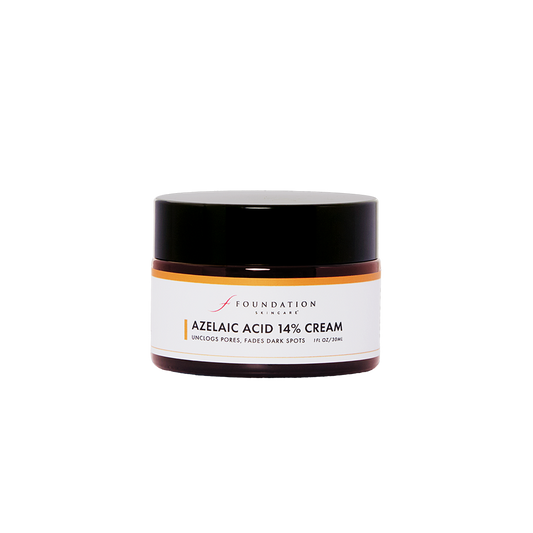
Azelaic Acid 14% Cream
• Brightens skin, fades brown spots
• Unclogs pores, improves texture
Sale price
$45
How to Use Foundation Skincare and The Ordinary Azelaic Acid
Foundation Skincare Azelaic Acid 14% Cream
With Foundation’s Azelaic Acid 14% Cream, the product should be applied last in your skincare routine, but before sunscreen for a morning application. It can be used twice daily, but be sure to use a pea-sized amount as a little goes a long way.
The ingredient has a cumulative effect, so it’s important that you use it consistently. Feel free to layer with other products like Niacinamide Lotion 10% which calms skin and contributes to DNA repair. You can also use Hyaluronic Acid Lotion, which works as a magnet for skin hydration.
The Ordinary Azelaic Acid 10% Suspension
The Ordinary Azelaic Acid can also be used twice daily after cleansing and water-based serums and before oils, suspensions, or creams. It should also be used in conjunction with sunscreen. Patch testing is strongly advised.
Foundation Skincare vs. The Ordinary Azelaic Acid: Results
Foundation Skincare Azelaic Acid 14% Cream
With Foundation Skincare Azelaic Acid 14% Cream, users typically notice significant improvements in their rosacea and acne in just 30 days.
-
After 6–8 weeks, you’ll notice less redness and a softer feel. Flare ups will be reduced and heal faster as bacteria is destroyed and skin cell turnover increases.
-
After 3 months, skin conditions should be considerably improved, with skin texture, brightness and hyper-pigmentation under control and inflammation reduced. These effects may be more noticeable and occur faster when combined with other products.
The Ordinary Azelaic Acid 10% Suspension
When using The Ordinary Azelaic Acid, some users report seeing changes in their skin within weeks while others have seen no results after several months of using the product.
Using the Ordinary product in combination with other products may offer more pronounced effects, but certain products can also cause irritation or dryness, so results should be closely monitored.
Bottom Line: The Ordinary vs. Foundation Skincare Azelaic Acid
It’s undeniable that both The Ordinary Azelaic Acid 10% Suspension and Foundation Skincare’s Azelaic Acid 14% Cream have positive effects on the skin, as azelaic acid is a superstar ingredient, but they do vary in a few key ways.
-
Foundation’s formula contains a higher concentration of azelaic acid. At 14%, it’s considered medical-grade and may offer more noticeable results for concerns like rosacea, acne, and pigmentation without requiring a prescription.
-
The products contain different supporting ingredients. The Ordinary’s formulation contains a few ingredients associated with negative health outcomes and does not contain aloe leaf juice, while Foundation Skincare’s product contains aloe leaf juice helps to prevent drying out the skin or causing irritation.
-
The two formulas behave differently when layered with other skincare products. Foundation’s cream is designed to work well alongside ingredients like niacinamide and hyaluronic acid, while The Ordinary’s silicone-heavy formula may not pair as smoothly with some actives.
-
Results take time and consistency. Most people need several weeks of regular use before seeing improvements in redness, acne, hyperpigmentation, or overall skin texture.
Though The Ordinary’s product is an inexpensive choice when it comes to azelaic acid products, if you’re looking for a medical-grade product (without the prescription), then you may prefer Foundation Skincare’s Azelaic Acid Cream product. Suitable for all skin types and easy to add to your regimen, the product is dermatologist-formulated with carefully chosen ingredients proven to make a difference in your skin.
Learn more about how to use azelaic acid and why you should.
References:
-
Feng XI, et al. (2024). Azelaic Acid: Mechanisms of Action and Clinical Applications. https://pmc.ncbi.nlm.nih.gov/articles/PMC11512533/
-
Ghani HI, et al. (2021). An Investigation of Makeup Ingredients and their Effects on Acne Cosmetica with Dermatologic Practice Recommendations.
-
https://www.researchgate.net/publication/354561420_An_Investigation_of_Makeup_Ingredients_and_their_Effects_on_Acne_Cosmetica_with_Dermatologic_Practice_Recommendations
-
King SA, et al. (2023). A systematic review to evaluate the efficacy of azelaic acid in the management of acne, rosacea, melasma and skin aging. https://onlinelibrary.wiley.com/doi/full/10.1111/jocd.15923
-
Kolodziej MI, et al. (2022). Allergic contact dermatitis to phenoxyethanol: A rare, but possible cause of hand dermatitis. https://pubmed.ncbi.nlm.nih.gov/34921565/
-
Mariano-Rodriguez CA, et al. (2025). Azelaic Acid in Dermatology: A Review of Its Mechanism of Action. https://pmc.ncbi.nlm.nih.gov/articles/PMC12517662/
-
National Center for Biotechnology Information. (n.d.) Triethanolamine.
https://pubchem.ncbi.nlm.nih.gov/compound/Triethanolamine


